

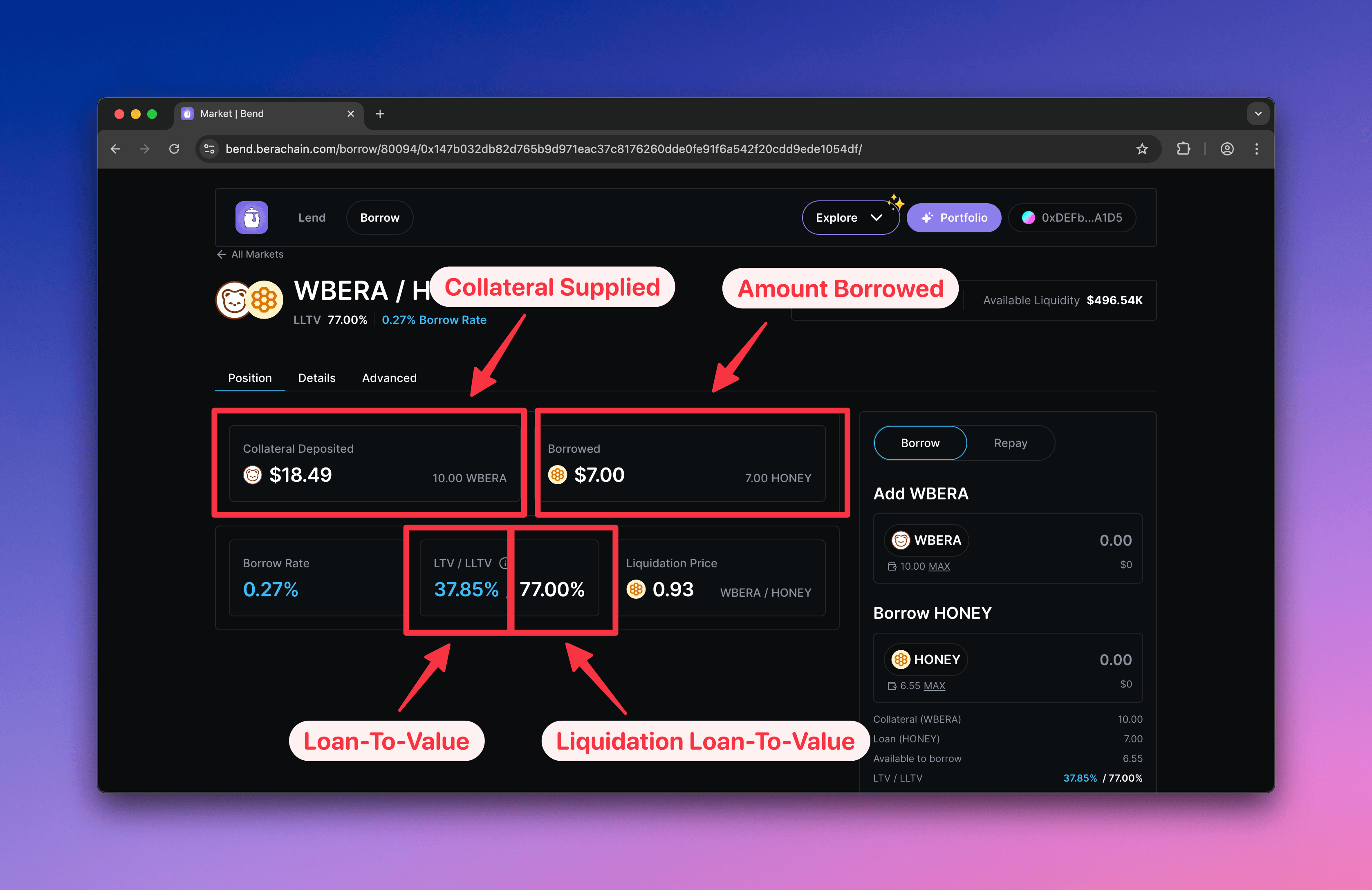
Collateral
Collateral is the asset you supply to a lending market to secure your loan. In a$wBERA/$HONEY market, $wBERA is the collateral. It guarantees that the protocol can recover funds if you default.
Your collateral is per market—not cross-margined. Supplying collateral does not generate yield.
Loan-to-value (LTV)
LTV measures debt as a share of collateral value. Use it to see how close a position is to liquidation.How to calculate LTV
Use this formula for a position on Bend: LTV = (BORROWED_AMOUNT / COLLATERAL_VALUE_IN_LOAN_TOKEN) x 100% Where:- BORROWED_AMOUNT: Borrowed assets (token base units)
- COLLATERAL_VALUE_IN_LOAN_TOKEN: Collateral value expressed in the loan token
- COLLATERAL_AMOUNT: Collateral supplied (token base units)
- ORACLE_PRICE: Market oracle price (scaled by ORACLE_PRICE_SCALE)
- ORACLE_PRICE_SCALE: Protocol scaling factor for prices
Liquidation LTV (LLTV)
Liquidation Loan-to-Value (LLTV) is the maximum LTV before a position can be liquidated. It is fixed per market and set at creation from a governance-approved list. If LTV ≥ LLTV, the position can be liquidated. Example: if a market’s LLTV is 86%, your position is at risk once your LTV reaches or exceeds 86%.Health factor
Health factor shows how close a position is to liquidation: HEALTH_FACTOR = (COLLATERAL_VALUE_IN_LOAN_TOKEN x LLTV) / BORROWED_AMOUNT- LLTV: Market liquidation threshold (e.g. 0.86 for 86%), in WAD (10^18)
Example: LTV and health factor
Example with assumed values:- Borrowed amount: 150
$HONEY(150 × 10^18 base units) - Collateral amount: 100
$WBERA(100 × 10^18 base units) - Oracle price: 3
$HONEYper$WBERA(3 × 10^18) - Oracle price scale: 10^18
- LLTV: 86% (0.86 × 10^18 WAD)
Step 1 — Collateral value in loan token
Collateral value = 300$HONEY.
Step 2 — Current LTV
Step 3 — Health factor
Summary
| Metric | Value |
|---|---|
| Current LTV | 50.00% |
| Max LTV (LLTV) | 86.00% |
| Health Factor | 1.72 |
| Status | Healthy |
| Liquidation buffer | 36.00% |
$WBERA (18 decimals, 3 $HONEY each) collateral against a $HONEY (18 decimals) loan, using WAD scaling for on-chain math.
Oracles
LTV and health factor depend on the oracle price.- Dynamic pricing: The oracle gives the current exchange rate between collateral and loan assets.
- Oracle design: A market’s oracle can combine several feeds or other on-chain data.
- Risk: Your LTV and health factor are only as reliable as the oracle. Latency, inaccuracy, or manipulation affect positions.