$BGT token. This page explains the mathematical principles behind validator selection, block rewards, and emissions calculations.
Validator selection
The network maintains an active set of 69 validators who are eligible for block production. Selection criteria include:- Only top 69 validators by
$BERAstake are included in active set - Block proposal probability is proportional to staked
$BERAand does not affect reward amounts - Stake limitations per validator:
- Minimum: 250,000
$BERA - Maximum: 10,000,000
$BERA
- Minimum: 250,000
$BGT emissions structure
When a validator produces a block,$BGT tokens are emitted through two emission components:
-
Base Emission
- Fixed amount equal to a
base rateparameter (B) - Paid directly to block-producing validator
- Fixed amount equal to a
-
Reward Vault Emission
- Variable amount dependent on validator’s boost (x)
- i.e. percentage of total
$BGTdelegated to the validator
- i.e. percentage of total
- Distributed to Reward Vaults selected by validator
- Proportional to weights configured in the validator’s Reward Allocation
- Validators receive Incentives from projects based on amounts directed to their Reward Vaults
- Variable amount dependent on validator’s boost (x)
Validator boosts
Boost is a crucial metric that determines a validator’s reward emissions:- Calculated as the percentage of
$BGTdelegation a validator has compared to the total$BGTdelegated in the network - Expressed as a decimal between 0 and 1
- Example: If a validator has 1000
$BGTdelegated and the network has 10000 total$BGTdelegated, their boost would be 0.1 (10%). Higher boost leads to higher reward emissions, subject to the emission formula.
BeraChef: Reward allocation management
BeraChef is the core contract that manages how validators direct their BGT rewards across different Reward Vaults. It serves as the configuration layer that determines reward distribution based on validator preferences.Core responsibilities
BeraChef manages three key aspects of the reward system:- Reward Allocations - Maintains lists of weights that determine the percentage of rewards going to each Reward Vault
- Validator Commission - Manages commission rates that validators can charge on incentive tokens
- Vault Whitelisting - Controls which vaults are eligible to receive BGT rewards
How reward allocations work
Each validator can set a custom reward allocation that specifies how their BGT rewards should be distributed. Reward Allocations are described by:- A list of selected vaults and the percentage of a given block’s BGT reward to send to each. The weights must sum to 100.
- The block number the allocation becomes effective.
Commission management
BeraChef manages validator commission rates on incentive tokens with the following constraints:- Default Commission: 5% if not explicitly set
- Maximum Commission: 20% hard cap enforced by the contract
- Change Delay: Required waiting period before commission changes take effect
$BGT emissions per block
The total$BGT emitted per block is calculated using the following formula:
Parameters
| Parameter | Description | Impact |
|---|---|---|
| x (boost) | Fraction of total $BGT delegated to validator (range: [0,1]) | Determines $BGT emissions to Reward Vaults |
| B (base rate) | Fixed amount of $BGT for block production | Determines baseline validator rewards |
| R (reward rate) | Base $BGT amount for reward vaults | Sets foundation for reward emissions |
| a (boost multiplier) | Boost impact coefficient | Higher values increase boost importance |
| b (convexity parameter) | Boost impact curve steepness | Higher values penalize low boost more severely |
| m (minimum boosted reward rate) | Floor for reward vault emissions | Higher values benefit low-boost validators |
Sample emissions chart
Using the following sample parameters, the chart below shows how emissions scale with$BGT delegation:
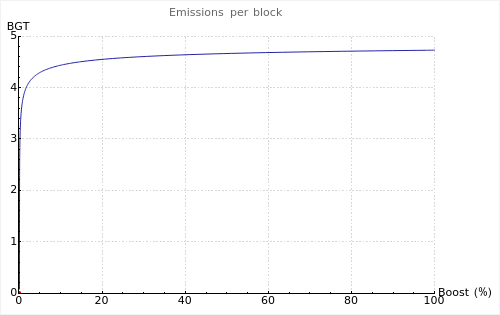
Max block inflation
$BGT emissions grow with the amount of boost a validator has, up to a cap. The maximum theoretical block emission occurs at 100% boost:
$BGT distribution
The Distributor emits$BGT to reward vaults on a per-block basis. The network processes distributions for a given block during the following block. This creates $BGT that Reward Vault stakers can then claim.
The network creates rewards on a per-block basis; however, it distributes them over a three-day period. Depositors receive rewards streamed linearly over this period, proportionally to their deposit amounts. The reward window resets each time new rewards arrive.
Distribution example
On Berachain,$BGT is distributed per block, meaning that the three-day distribution period is consistently being pushed to “start” on the current block. Thus, this period should be viewed as a sliding window based on the emissions at any given time during the previous three days.
A more real-world example with simplified numbers:
- 3
$BGTdistributed daily, for a total of 27 over 9 days - 1 depositor, owning all the deposits
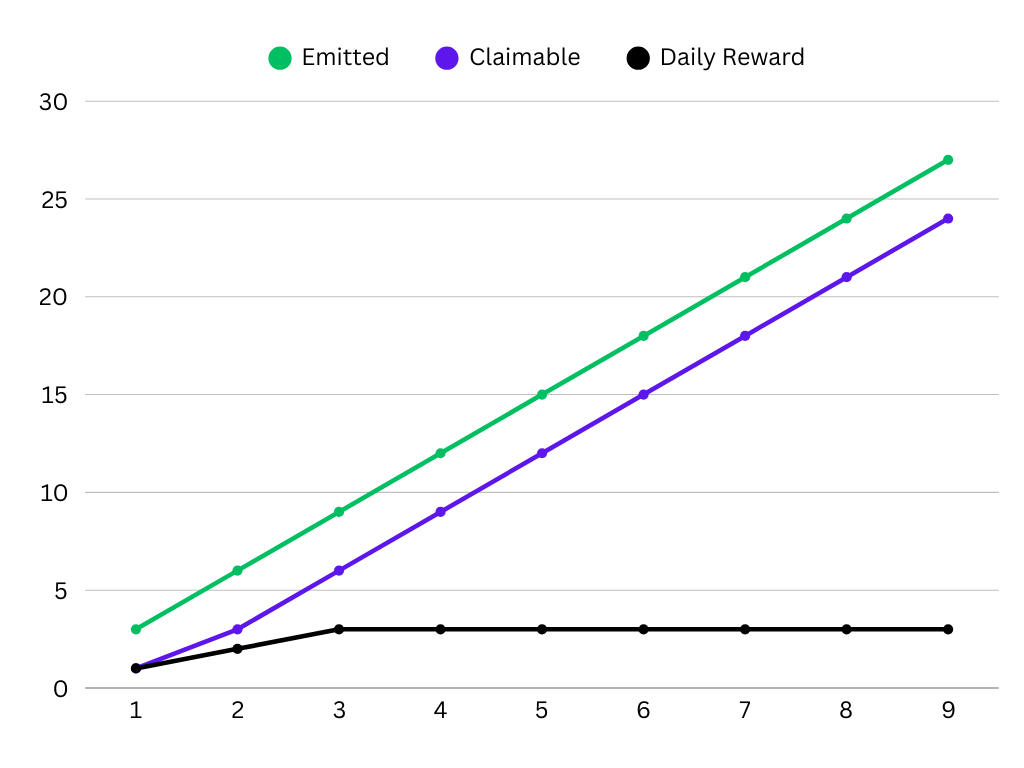
- Emitted: Total number of
$BGTdistributed and available - Claimable: Total number of
$BGTable to be claimed by depositors - Daily Reward: Daily number of
$BGTmarked as claimable based on emitted tokens unlocks
$BGT daily until rewards reach a saturation point after three days where all rewards are actively being distributed.
Reward duration periods incentivize ecosystem alignment with depositors via this distribution mechanism rather than allowing rewards to be instantly claimed.
Calculating boost APR
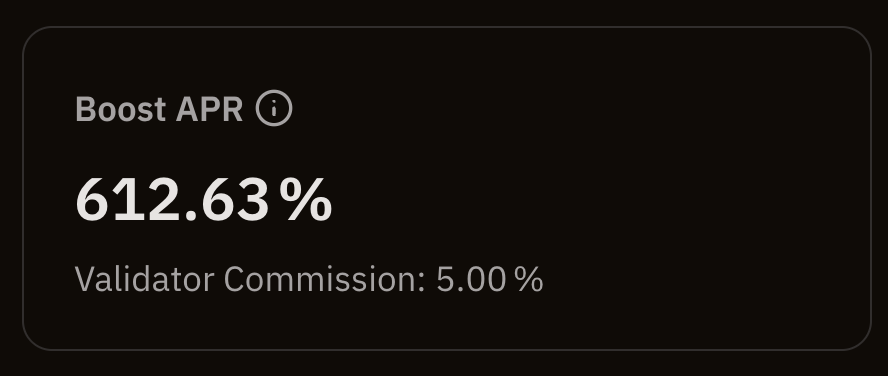
Boost APR is shown throughout the Berachain Hub.