

$BGT rewards. Reward Vaults are the only way anyone can earn $BGT rewards, and therefore serve the important function of gating entry into the PoL ecosystem.
Reward Vaults are key infrastructure that allows protocols to leverage PoL, enabling teams to incentivize actions in exchange for $BGT. A protocol can have multiple Reward Vaults, each with its own PoL-eligible asset to be staked. For example, BEX can have multiple pools earning $BGT, each with its own Reward Vault and respective PoL-eligible asset.
Only Reward Vaults approved through governance are eligible to receive
$BGT emissions from Validators.Please see the full Berachain Reward Vault Requirements & Guidelines for the application process.User interactions
Staking with a reward vault
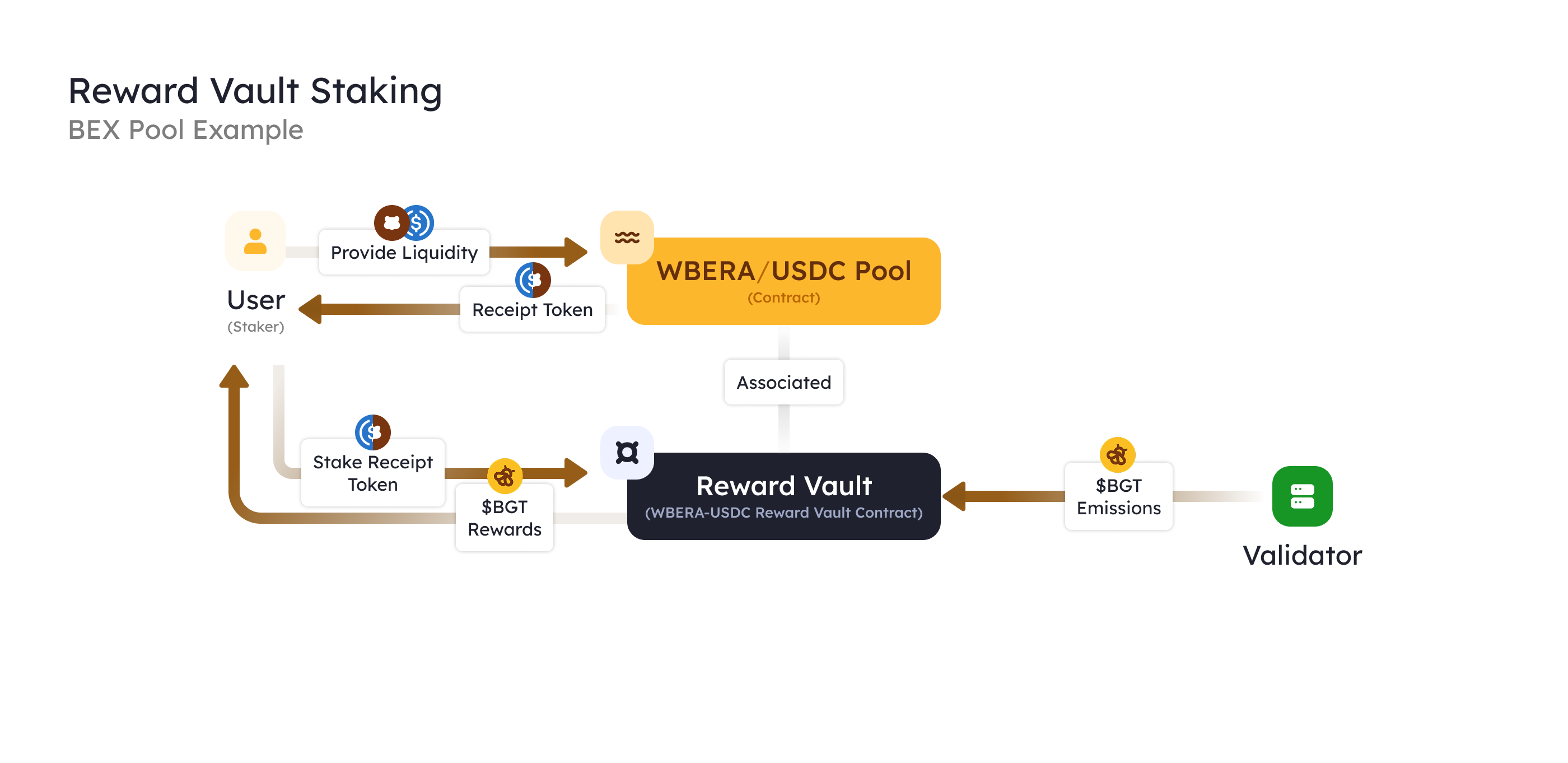
$BGT, a user must stake the PoL-eligible asset in its Reward Vault. The protocol that deployed the Reward Vault decides how users acquire the PoL-eligible asset to stake. The idea is that protocols would leverage this to attract liquidity or stimulate activity, and in return award users with the asset they can stake in their vault.
- The user takes some action that results in receiving a PoL-eligible asset, generally referred to as a receipt token.
- The user stakes the PoL-eligible asset in the corresponding vault.
- The user earns a portion of all the BGT emitted to that vault.
Earning BGT
The amount of$BGT rewards a user earns from a Reward Vault is a function of:
- The user’s share of total assets staked in the Reward Vault
- The amount of
$BGTrewards emitted to the Reward Vault
$BGT farming with Reward Vaults is meant to resemble familiar DeFi actions, providing a low barrier to entry.
Delegation
The RewardVault supports delegation, which allows one address (the delegate) to stake tokens on behalf of another address (the account holder). This enables use cases such as:- Custodial staking: Exchanges or custodians staking on behalf of users
- Smart contract integration: Protocols automatically staking user funds
- Managed staking services: Third-party services handling staking operations
- Delegate: The address that deposits/withdraws tokens (msg.sender)
- Account: The address that owns the staked position and receives rewards
- Self-staked balance: Tokens staked directly by the account holder
- Delegated balance: Tokens staked by delegates on behalf of the account
$BGT flow
When a validator is chosen to propose a block, they direct a portion of their$BGT emissions to specific Reward Vaults of their choice. To learn more about how $BGT is calculated in block production, check out the docs on block rewards.
BGT emission modes
Reward Vaults operate in one of two mutually-exclusive modes for BGT reward distribution timing:Duration-based mode (legacy)
In this mode, therewardDurationManager sets a fixed rewardsDuration (typically 3-7 days). Each time BGT rewards are added to the vault via notifyRewardAmount, the BGT is distributed evenly over this predetermined period.
Duration-based mode enforces the 3-7 day range: if switching from target rate mode where the duration exceeded 7 days, the duration will be capped at 7 days.
Example: If 100 BGT is added with a 5-day duration, the vault distributes 20 BGT per day to stakers.
Target rate mode
WhentargetRewardsPerSecond is set to a non-zero value, the vault automatically calculates the optimal distribution period for each BGT deposit. The vault ensures the emission rate never exceeds the target while respecting the minimum duration limit.
The computation follows this formula:
Switching between modes
setTargetRewardsPerSecond(x)enables target rate modesetTargetRewardsPerSecond(0)re-enables duration-based mode- Only the
rewardVaultManagercan switch modes
Incentive management
RewardVaults support incentive tokens, which are additional tokens that protocols can offer to BGT stakers beyond the base BGT rewards. This creates a powerful mechanism for protocols to attract liquidity and user engagement.How incentive tokens work
- Whitelisting: Protocol tokens must first be whitelisted in the vault by governance
- Exchange Rate Setting: Protocol managers set exchange rates (e.g., “10 USDC per BGT earned”)
- Token Deposits: Protocols deposit their tokens into the vault
- Automatic Distribution: When users earn BGT, they automatically receive proportional incentive tokens
Incentives
To understand why validators would choose to emit$BGT to one Reward Vault over another, refer to Incentives in PoL, which discusses how protocols can influence validator behavior with economic incentives.
Vault creation
New Reward Vaults can be created permissionlessly at Berachain Hub. Protocols creating Reward Vaults must additionally whitelist their vaults through$BGT governance to be eligible to receive emissions from validators.
Calculating $BGT APR
The RewardVault APR is determined by several factors. The components of this APR calculation include:rewardRate- The BGT amount added to Reward Vault Staker’s total claims per secondperiodFinish- The timestamp when therewardRateexpiresstakeToken- The token you stake into the Reward VaulttotalSupply- The total amount ofstakeTokenstaked in the Reward Vault- Price of
$BGT($BERA) - The assumption is made the price of$BGTis equivalent the$BERAprice - Price of Stake Token
If the
periodFinish timestamp has elapsed no rewards are being emitted. As a result, the $BGT APR is 0%.rewardRate is denominated as $BGT per second. The above pieces of data allow you to calculate the APR on the Reward Vault in the following way:
This formula provides the current rate that the Reward Vault is crediting depositors with $BGT.
Example
As a concrete example of the above formula, a reward vault with the following values can be used:| Parameter | Value | Normalized |
|---|---|---|
| Reward Rate | 272490527103681170793308992914391673 | 0.27249052710368116 |
Price of $BERA | $7.8 | $7.8 |
| Total Supply | 598626940947001140289 | 598.6269409470011 |
| Price of Stake Token | $223,845.58 | $223,845.58 |
| Seconds per year | 31,536,000 | 31,536,000 |